
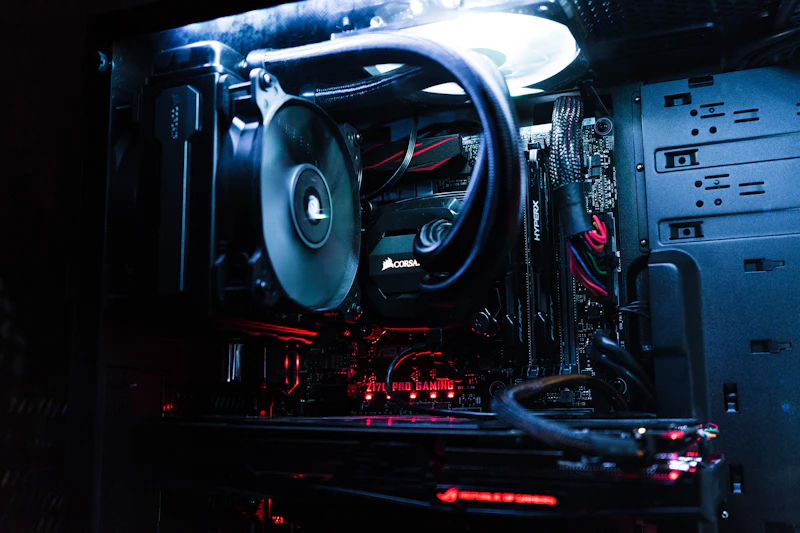
Every component in a water-cooled loop moves heat. The pump pushes it, the blocks collect it, the tubing carries it. The radiator is the only part that actually gets rid of it. If the radiator is undersized, nothing else in the loop matters — the coolant temperature climbs, the fans spin up, and the components throttle. Sizing a radiator is not a preference. It is arithmetic.
The 120mm-per-100W Rule
The standard starting point is simple: 120mm of radiator per 100W of heat. Add the TDP of your CPU and GPU, divide by 100, and you have the number of 120mm fan slots your loop needs. A flagship example: a 253W CPU paired with a 450W GPU totals roughly 700W, which calls for seven 120mm slots — a 360mm radiator plus a 240mm, or two 360s if the case allows.
That number assumes a temperate climate. In Riyadh, where summer ambient air passes 45°C, we add 20–30% headroom on top of the rule. A loop that is comfortable in Berlin is marginal in August in Riyadh. When we spec a build, the radiator area is calculated against the room the machine will actually live in.
Thickness vs. Fans
Radiator thickness is a trade, not a free upgrade. A slim 30mm radiator works with almost any fan and fits tight chassis. A 45–60mm thick radiator has more fin surface, but it needs high-static-pressure fans to push air through the dense core — and it needs the space. In the Gamemax Hotwheel, where the circular chassis hides the loop behind glass, space is the constraint. We choose slim radiators with premium fans rather than thick radiators with weak airflow.
Push, Pull, or Both
Push/pull — fans on both sides of the core — adds a few degrees of improvement at low fan speeds, and it is mostly an acoustic win: the same airflow at lower RPM per fan. The gains shrink quickly once the fans spin up. If the case has room and you want silence, run push/pull. If space is tight, a single quality fan set is enough.
Why CGP Specs Radiators Per Build
We do not pick radiators from a parts list. Every CGP loop is measured against the actual chassis, the actual components, and the actual climate. The radiator range in the shop — 120, 240, and 360 — covers every configuration we build, and the configurator accounts for radiator area before a single tube is bent. Get the radiator right and the loop is quiet, cool, and stable. Get it wrong and no amount of pump speed will fix it.
If you are planning a build, start with the configurator — it sizes the loop for you. If you want to talk radiator math with a human, contact us.
SIGNED BY THE HANDS THAT BUILT IT
CGP Team